Dressmaker Tips and Tricks
Updated
Here's how Dressmaker scores a dress, how to reach 100% Quality, and 15 tips for the most common reasons a dress loses stars. Most of them are about doing the free thinking first — design, colours and layout — so the expensive part goes right the first time.
How Quality is scored, and how to reach 100%
The Quality line on every card comes from three things you control, and none of them is how much your fabric cost. Community testing on Dressmaker Wiki weighs them like this:
| Part | Worth | How to max it |
|---|---|---|
| Sewing | 50 points | Stay on the guide line; slow down at corners (S lowers speed). Sewing Assist can steer for you. |
| Cutting | 30 points | Turn each piece until its grain label reads 100% before you cut. |
| Fit | 20 points | Set the mannequin to the client's true size from the measurements table. |
Making money
- Burlap is free. Use it to mock up a layout before buying real fabric, or sew whole burlap dresses and sell them for pure profit.
- Sell leftovers. Fabric left over from a commission still makes a dress you can sell from the finished-dress box, which shows the price before you confirm.
- Sew cleanly. Sale prices scale with Quality, so a sloppy dress can sell for less than its materials cost.
1. Solve the style tags before spending money
Swapping bodices, sleeves and skirts in the sketchbook is free. Keep iterating until every requested tag is met, then shop.
2. Treat explicit “no”s as hard rules
If a client rules out a colour (Prudence and black, Priya and anything bright), respect it — it outweighs small design wins.
3. Get the mannequin to a true 100%
Fit feeds into quality. Match all three dials exactly — see the measurements table.
4. Plan colours with the pencils
Colouring your sketch shows which areas share a fabric, so you buy the right amounts and don't waste budget.
5. Start with two or three fabrics
Fewer fabrics are easier to visualise, cheaper, and faster to cut. Add a third colour only when the request asks for it — Fiona's gardening dress does.
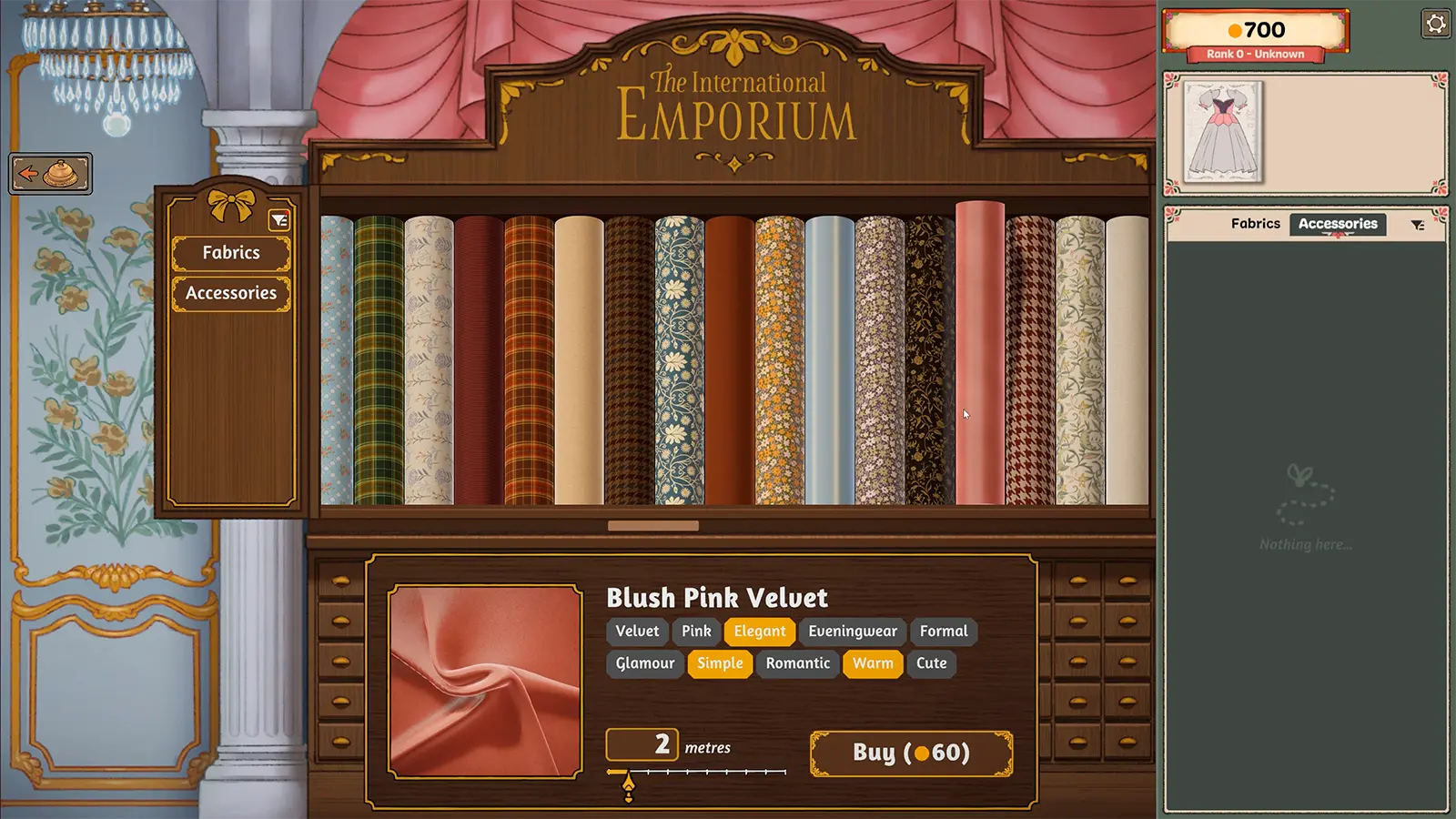
6. Use the Emporium filters
Filter fabrics and trims by the attribute you need instead of browsing everything.
7. Treat the budget as your pay
The budget on a card is what the client pays when you hand the dress in, pass or fail. It isn't a spending cap and doesn't affect the rating, but everything you spend beyond it is a loss, so use cheap fabric where the card doesn't ask for anything special.
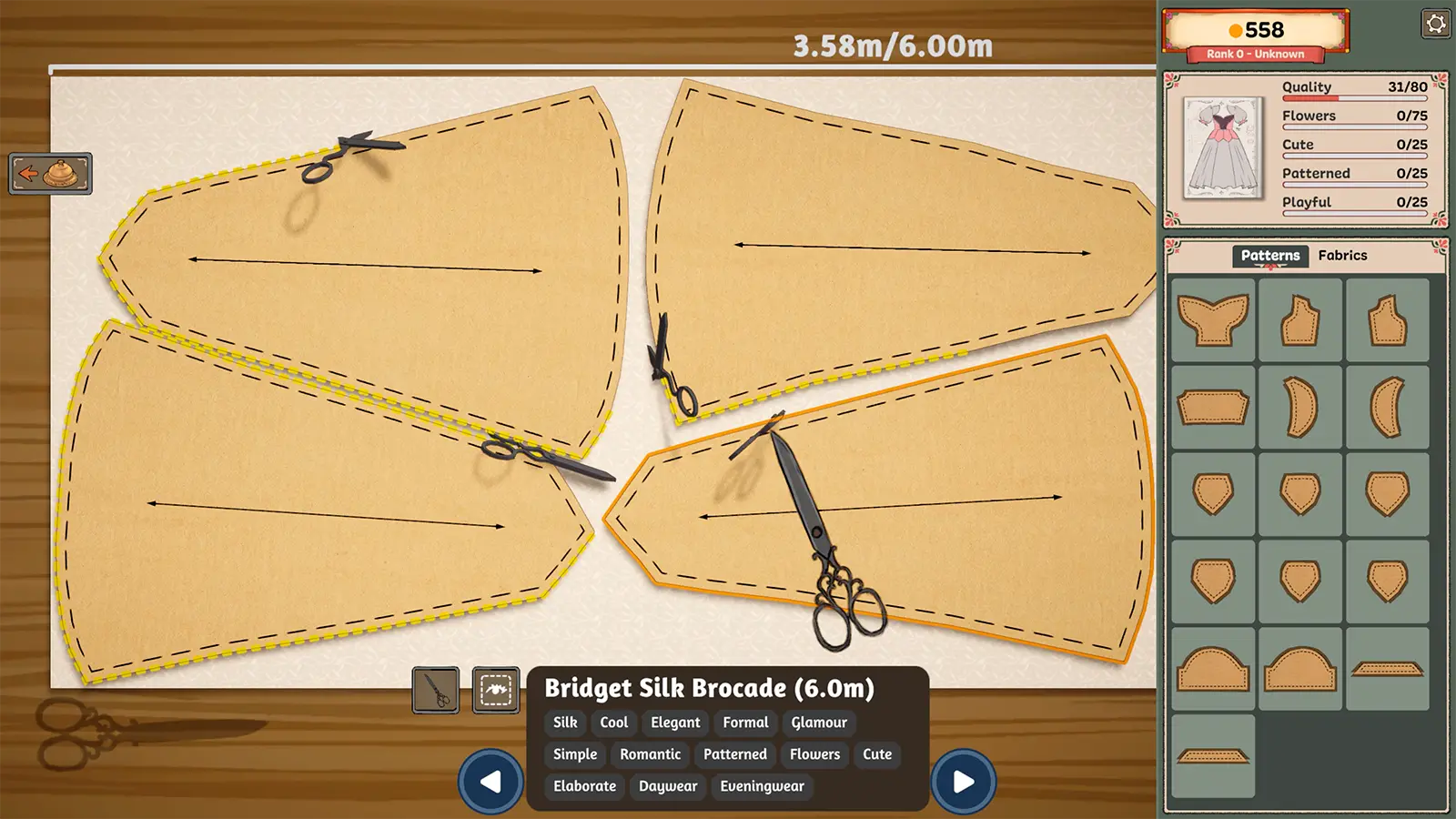
8. Line up every grain arrow
A misaligned piece caps quality no matter how neatly you sew. Wait for every piece to turn green.
9. Pack pattern pieces tightly
Nesting pieces close together gets more out of each length of fabric and stretches your budget.
10. Sew fast on straights, slow on curves
Straight seams tolerate speed; curves are where quality slips. Ease off before each bend.
11. Use accessories on purpose
Accessories carry tags too — a silk flower adds Flowers — and some cards require them (a brooch, feathers, tassels, bows). Beyond that, add them last and only if the budget allows.
12. Watch for caps and hard rules
Some cards cap a tag (Rose's Chilly Overtime: Cute 20 max) or demand a fabric share, colour or accessory count. Missing a rule fails the card however beautiful the dress — see every card on the commissions list.
13. Fix seams before you deliver, not after
Once a dress is handed in, the result is final. If a seam or piece is short, choose Keep working on the finished-dress box, unpick the panel with the seam ripper, scrap it in the basket at the cutting table and redo just that piece.
14. Never gift a commission dress
Gifting builds friendship, but players report that gifting a dress made for an open commission can stall that story. Gift spares only.
15. Match fabric to the occasion
Silk and velvet for formal events, wool for professional looks, cotton and linen for everyday and outdoor dresses.
New to the game? Start with the full Dressmaker walkthrough.
Frequently asked questions
How do you increase quality in Dressmaker?
Set the mannequin to the client's exact measurements, lay every pattern piece so its grain arrow reads 100% before cutting, and sew slowly on curves with Sewing Assist on if you like. Redo a weak seam with the seam ripper rather than starting over.
Why is my dress stuck at 80 quality?
If every piece reads 100% and the seams are clean but Quality sits around 80, the fit is the problem: the mannequin doesn't match the client's true measurements. Set the dials to the values on our measurements page.
Are there cheats in Dressmaker?
No. The game has no cheat codes or console. Sewing Assist in the settings takes over the steering while you sew, and players report it doesn't lower your score. Free burlap and selling off-the-rack dresses are the legitimate ways to get ahead on gold.
How long is Dressmaker?
The main story runs to about 35 hours of commissions, and finishing every achievement takes most players 40 to 50 hours.
Why did my dress get a low rating?
The usual causes are a style tag the client asked for that isn't met, a colour or fabric rule broken, pattern pieces cut off the grain line, wobbly sewing on curved seams, or a mannequin that doesn't match her true measurements.
Are accessories worth buying?
Yes, when a card needs a tag you're short on or asks for a specific accessory. Accessories carry style tags of their own, and some cards require a set number, such as a brooch or four feathers.
Sources
Keep reading
Dressmaker Guide
Everything about Dressmaker, the cozy sewing game from Cozy Lives: release date, price, platforms, customers, measurements and a full walkthrough.Characters & Customers
All 10 Dressmaker customers and NPCs, from Rose to Adora: measurements, every commission card, what each one likes as a gift, and her story achievement.All Commissions
Search all 77 Dressmaker commission cards by client, event or style tag: every requirement and budget, plus a checker that tells you if your dress will pass.Measurements
Bust, waist and hip measurements for all 10 Dressmaker clients, from Rose and Prudence to Marie, how close the mannequin has to be, and what a bad fit costs.Walkthrough
Dressmaker walkthrough: how a commission works step by step, all 53 story cards in the order they arrive, and when each optional and event card unlocks.Free Demo / Prototype
Dressmaker has a free prototype on itch.io. Where to download it, whether you can play it in a browser, and how it differs from the full game.